This is a rush transcript. Copy may not be in its final form.
AMY GOODMAN: This is Democracy Now! I’m Amy Goodman.
With the midterm elections less than three weeks away, could the Democrats win back control of the House and the Senate? Election Day is November 3rd. Democracy Now! will be doing a four-hour broadcast from 8:00 to midnight Eastern Time that day. But at least 47 states and Washington, D.C., have early voting, with voters already casting ballots in some states. All 435 House seats and 33 Senate seats are on the ballot, in addition to some statewide races and ballot measures.
The list of battleground Senate states has been growing. As many as 10 Senate seats could be flipped, including several states that have been longtime deep-red Republican seats. Competitive races now include Ohio, Alaska, Texas and Kansas. Kansas has not sent a Democrat to the Senate in nearly a century. To win the Senate, Democrats need to flip four Republican seats and hold three of their own. They must hold Michigan, where Dr. Abdul El-Sayed is running against Republican Mike Rogers for an open seat.
President Trump’s been on the campaign trail. He spoke at a rally in Wasilla, Alaska, Tuesday, where incumbent Republican Dan Sullivan is facing off against Democratic challenger Mary Peltola, former congressmember and tribal judge. If she and Peggy Flanagan in Minnesota and Deb Haaland, running for governor in New Mexico, to win, it would be a historic three Native American women in the governorships and the Senate. This is President Trump speaking in Alaska.
PRESIDENT DONALD TRUMP: On November 3rd, we’re going to send one of the best and most respected senators in D.C., Dan Sullivan, the real — the real Dan Sullivan. … I’m talking about the real Dan Sullivan, not the fake Dan Sullivan, not the Dan Sullivan put up by the “Dumocrats.” … I want you to do me one big favor: pretend that I’m on the ballot. Because here’s what happens: Every time I’ve been on the ballot, we win. … So, in conclusion, if you elect a Republican House and a Republican Senate November 3rd, you get $5,000.
AMY GOODMAN: Key issues raised by challengers and voters have been the economy, the war in Iran, the cost of gas, immigration, data centers and corruption.
To discuss all this and more, we’re joined by David Sirota, founder and editor-in-chief of The Lever. He’s author of Master Plan: The Hidden Plot to Legalize Corruption in America.
Why don’t we go through a number of the states, beginning in Georgia, David, and talk about the overall picture? What’s at stake here? As we talk, President Trump is surprising many by going through this deep-red state tour, which indicates he is fearful of losing not only the House, but the Senate, and, of course, what that could mean for, for example, investigations of him.
DAVID SIROTA: Yeah, I mean, it’s kind of incredible that Trump is out on the campaign trail, in particular in red states, in the sense that he is helping turn the election into even more of a referendum on himself when he is deeply unpopular in polls. So, in a sense, I think, at one level, he is doing the Democrats a big favor by being so extra visible in the states where the Democrats are trying to expand the map. You know, states like Kansas, states — even potentially, if you believe polls, states like South Carolina appear to be in play, the Democrats challenging in the polls there. Florida also a pretty red state.
You mentioned Georgia. Georgia is a different situation, where that’s a state where the Democrats have to hold that state. There’s an incumbent, Jon Ossoff, there. Georgia, a real purple state. And Ossoff has done a fantastic job of turning the race into a referendum on his own Republican challenger. His Republican challenger is a member of Congress. So, he has essentially turned the race into — in an anti-incumbent year, he has effectively tried to, and I think succeeded at, turning the race into a referendum on his opponent and made his opponent out to be, effectively, the incumbent, Mike Collins. And he’s brought up Collins’ association with people who are linked to white nationalism.
But across all of these races, I do think —
AMY GOODMAN: Let me go to — I want to play a clip of Jon Ossoff, the current Democratic senator, speaking to supporters in Athens, Georgia, last month.
SEN. JON OSSOFF: Five days after his father was reelected, Prince Don Jr. becomes a partner at 1789 Capital, a venture firm founded by right-wing activists and Trump donors. 1789 Capital then buys a stake in Vulcan Elements, a tiny startup that says it plans to produce the high-tech magnets needed in drones, missiles and satellites.
And about a month after Don Jr.'s venture firm buys its stake in Vulcan Elements, Pentagon officials learn that Peter Navarro, a convicted criminal, Don Jr. close friend and a top White House official, wants the Pentagon to give your tax dollars to Vulcan Elements. One Pentagon official said, quote, “The call came from the White House. We have to get this done.” And, Athens, to be clear, getting this done means funneling your money to the president's son’s investment.
And so, of course, like clockwork, on November 21st, just three months after Don Jr. and his friends bought their stake, Vulcan gets a $620 million taxpayer loan from Pete Hegseth’s Pentagon, paid for with your money. See, while the world burns and you pay more for everything, your tax dollars become the royal family’s wealth, because it pays to be a Trump, especially when the whole world knows daddy’s a crook.
AMY GOODMAN: That’s Jon Ossoff. He faced off last night in a debate, and one of the major issues that was raised is: Is he running for Senate, or is he running for president? And that’s true of a number of the people who are running for governorships or Senate, David Sirota.
DAVID SIROTA: Yeah, I mean, that’s a big question for Jon Ossoff. And I think in that clip, I think it’s important to note that what Ossoff is doing there, I think pretty successfully, and you’ve seen this with James Talarico and some others — James Talarico running in Texas — is trying to connect the corruption issue with the affordability crisis. And this is a key theme that we talked about in Master Plan, our — The Lever's podcast, where the corruption issue for many years has been a kind of abstraction. People don't like corruption. People understand the government — there’s a lot of corruption in the government, but that it becomes a much more salient issue when people have a better understanding of how the corruption is raising their prices and creating the affordability crisis. Ossoff has made that a central theme. James Talarico, running for Senate against Ken Paxton in Texas, has made that a central theme, tracing the donations that Paxton has gotten to his votes to expand data centers.
AMY GOODMAN: David, I want to play a clip. This was an ad released by James Talarico, who is ahead. And this is the first time in decades a Democrat ahead of the Republican in the race for Senate. This is James Talarico’s ad.
JAMES TALARICO: Twelve million dollars. That’s how much Ken Paxton’s corruption has cost Texas taxpayers in legal fees and settlements. Guys like him always expect you to pick up the check. I’ve passed bills to lower the cost of housing, healthcare and property taxes. In the Senate, I’ll take on the data centers raising our costs and fight to end the wars driving up gas prices. I’m James Talarico, and I approve this message.
AMY GOODMAN: So, that’s James Talarico. And you heard our election headline. The Wall Street Journal has published video of the Texas Republican Attorney General Ken Paxton, the Republican nominee for Senate, partying in Dubai in 2024, New Year’s Eve, with two indicted fugitive healthcare executives and a woman not his wife. Two men had been indicted months before on federal healthcare fraud charges and didn’t return to the United States. One of the healthcare executives had donated $190,000 to Paxton. And Talarico’s response online was “A party with multiple fugitives, and Ken Paxton is still the sketchiest guy in the room.” And let’s be clear, Ken Paxton, who, to many people’s surprise, was endorsed by President Trump over longtime Senator Cornyn, has been indicted by his — has been impeached by his own party, David Sirota.
DAVID SIROTA: Yeah. So, this race is really the pinnacle of the Senate race in terms of how it embodies the themes in this election. I mean, you have a cartoonishly corrupt Republican Senate candidate against a new-generation populist Democrat. And it’s worth adding that Talarico has really cast himself as an anti-oligarch, anti-billionaire candidate. I mean, I would not call him necessarily a Bernie Sanders candidate, but, clearly, a lot of the themes that you heard in the 2016 and 2020 elections with Bernie Sanders in the primaries there, these are being echoed on the campaign trail by Talarico and by other Democrats, even in these purple and red states, which I think is a reminder of how much the so-called Overton window has shifted in American politics, where those themes, those anti-corruption, populist, anti-oligarch themes, are now very mainstream.
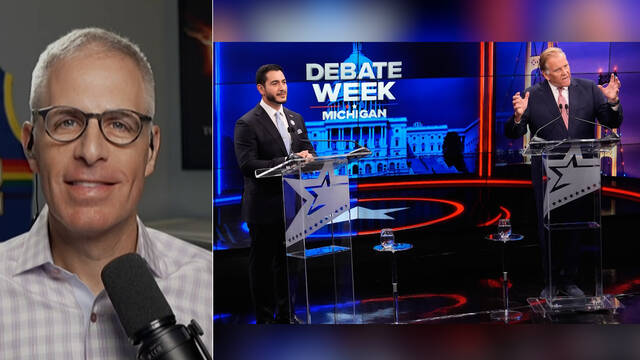
AMY GOODMAN: OK, you mentioned Michigan. The Senate candidates just recently debated. This is Republican Mike Rogers, followed by [sic] Democrat Abdul El-Sayed, in an exchange over U.S. support for Israel and the war in Iran, in a debate held in Grand Rapids. El-Sayed is blaming rising gas prices on the war.
DR. ABDUL EL-SAYED: It is insane, $80, $80 to fill up your gas tank. And yes, I would support pausing the federal gas tax. But there is one thing that is actually causing this. It’s the war in Iran, a war that has been cheerled by my opponent since the beginning, called it a win-win-win. I don’t know about you, but when I go to the gas tank, I don’t feel like I’m winning. I don’t feel like our country is winning.
MIKE ROGERS: His policies will raise your — your — the cost of every gallon of gasoline, number one, raise your utility rates, cause you $20,000 for a Medicare for All plan that takes away private insurance from individuals. It is a disaster. We cannot afford Abdul.
AMY GOODMAN: Talk about this race, David Sirota.
DAVID SIROTA: Again, another marquee race here. I mean, this is a race where, as I mentioned before, Bernie Sanders’ themes being central here. I mean, Abdul El-Sayed was very aligned with the Bernie Sanders wing of the Democratic Party, won a very, very difficult primary, with tons of money, tens of millions of dollars, spent against him. He wins this primary. He is ahead in the polls. And he is continuing to campaign on those themes.
It’s important that you underscored how central the war is in that race. Mike Rogers has been an embodiment of the national security state, and Abdul El-Sayed’s campaign has put that front and center, spotlighting his role in creating the surveillance state when Mike Rogers was in Congress, his role, his investments in data centers — again, data centers becoming an affordability issue. I think that’s key, that linking the data center buildout to higher electricity prices.
And I think the thing is, with this race, which is very important, is if Abdul El-Sayed wins running as a kind of Bernie Sanders-style populist in one of the marquee swing states in the country, it will destroy the argument from the corporate Democrats, at the center of the Democratic Party, that you have to be an archconservative, corporate kind of Democrat in order to win swing states. I think that’s why a lot of corporate Democrats inside the Democratic Party are afraid of Abdul El-Sayed winning. They know that it’s key for him to win in order to win the Senate, but they also know it will destroy their argument that the Democratic Party has to continue nominating more corporate-aligned candidates.
AMY GOODMAN: Let’s remember, he’s a doctor, Abdul El-Sayed, and he wrote a book, Medicare for All. That’s a major issue for him. But I want to turn to what is a major issue for President Trump. This is during a rally in Tennessee Saturday, repeatedly calling Abdul El-Sayed “Mohammed” and calling him a jihadist.
PRESIDENT DONALD TRUMP: Like Mohammed El-Sayed — I call him Mohammed. Somebody said, “His name isn’t Mohammed; it’s Abdul.” I said, “To me, it’s Mohammed.” I’m the president. I can call him whatever the hell I want. To me, he’s Mohammed, and he’s a radical jihadist.
AMY GOODMAN: That’s President Trump. Congressmember Alexandria Ocasio-Cortez said, “If Abdul can win in Michigan, anyone can win anywhere.” Your thoughts, David Sirota?
DAVID SIROTA: Yeah, I think that’s absolutely right. I mean, I think that’s why his race is so important. And I think — so, he’s taken on the headwinds of the Democratic Party first in the primary, the corporate Democratic faction spending tens of millions of dollars to vilify him and cast him as a terrorist sympathizer. Now he’s in a general election where Donald Trump is using all sorts of Islamophobia to amplify that message. And El-Sayed is campaigning for things like Medicare for All. And so, I think Alexandria Ocasio-Cortez is absolutely right. If Abdul El-Sayed can win a race like this in such an important so-called blue wall state, it means that his politics, what he represents, can win literally anywhere in the country.
AMY GOODMAN: I wanted to ask about whether predictions are overstated about who can win. In the primaries, progressives were surprised by the Wisconsin loss of Francesca Hong, who was polling very strongly. And then, of course, you had Dr. El-Sayed, who won the primary in a very close race with a sitting congressmember.
DAVID SIROTA: Yeah, I think we should all be skeptical of what the polls actually say. I mean, the question of whether there’s going to be a blue wave — is it a blue wave, a surge for Democrats? Is it potentially a red undertow, essentially a drag on the Republican Party? And how much of a drag? These are open questions, because I think the way polling has worked in the last few election cycles, we’ve seen a lot of polls that have not been accurate. And there’s a question about whether — are Republicans not answering polls because they don’t — they don’t answer the phone to pollsters or they don’t want to talk to pollsters? There are all these questions about this.
So, I am skeptical of all of these polls. I think it’s impossible to know what’s going on, beyond the fact that I do think it’s a safe bet that Donald Trump is deeply unpopular. So, it ultimately ends up being a turnout question. How much of a blue wave in terms of a turnout among Democratic voters? Will there be that surge of turnout based on how unpopular Trump is and how bad the affordability crisis is?
AMY GOODMAN: David, let’s go to Maine. Trump’s tariffs have been a major issue there. This is another key race for Democrats. An exchange last week in a debate between this longtime sitting Republican senator, Susan Collins, and Democratic candidate Troy Jackson.
SEN. SUSAN COLLINS: Troy mocked it, but I was successful in getting concrete, pulp and road salt removed from the tariff list.
TROY JACKSON: I didn’t mock the fact that she got road salt back. I mocked the fact that — what about everything else? I mean, we can’t eat road salt. And the thing about it is, is that everything that she’s doing with the Iran war and stuff like that, there’s going to be so many less people that’ll be able to afford to drive that I’m not even sure the road salt’s going to be worth anything, either.
AMY GOODMAN: And that is Troy Jackson, former Maine state Senate president, former logger, and longtime Senator Susan Collins, who’s dealing with a number of issues, from tariffs to her support for Brett Kavanaugh, which enraged the pro-choice community of Maine. She said she couldn’t have predicted he would vote to overturn Roe v. Wade. David Sirota?
DAVID SIROTA: Yeah, I mean, Susan Collins is doing what she always does when she’s running in a tough race in a Democratic-leaning state, which is insist that she’s an independent voice, that she’s separate from the Republican Party. And what Troy Jackson is doing is constantly pointing out how that’s not true, how she’s enabling the Republican Party. They’ve actually mocked her, I think pretty effectively, when she constantly says she’s concerned about the actions of her party, actions that she is supporting.
And what you saw in that clip is her trying to also make a very traditional argument that, “Hey, you may not like me very much, Democratic voters or independent voters, but I’m bringing home the bacon.” And what Jackson did, I think quite effectively, in that clip is turn that around and say, “You may say you’re bringing back road salt, but there are much larger macro issues that make how much you’re bringing home to the state a relatively minuscule issue compared to the fact that nobody can afford the basic necessities of life.”
Now, Maine has not elected a Democratic senator in a very, very long time, and so I do not count Susan Collins out. She is a very, very tough incumbent. But this would be the year.
AMY GOODMAN: And, of course, Bernie Sanders is, though, very popular, and he was just with Troy Jackson. He’s from neighboring Vermont. And, of course, he’s been going around the country. David Sirota, as we wrap up this discussion — again, we’re going to be doing a special on election night, and we’ll continue to cover these issues — your thoughts on what exactly would happen, both if there was a Senate-House Democratic takeover, and if there isn’t, if it’s House goes Democrat and the Republicans remain in charge of the Senate? And do you think, if there was a Senate-House Democratic sweep, that President Trump would be impeached again?
DAVID SIROTA: I don’t think President Trump will be impeached. I think that you’ve seen a lot of Democrats say they don’t want to pursue impeachment. They think that’s a — that path has been fruitless.
I think what you will see is, certainly, if Democrats win, much more scrutiny, using committee chairs, using subpoena power to scrutinize the self-dealing corruption of the Trump administration. I think you’ll see scrutiny potentially on Trump’s Cabinet secretaries, then brought before Congress to testify on all sorts of corruption allegations.
I think the question is going to be, for Democrats, if they win power: What do they actually stand for? And that is an unanswered question that’s going to be litigated also in the 2028 Democratic presidential primary. But I think the — if you look at 2006, a similar moment — second-term Republican president, Democrats win — there was a lot of excitement when Democrats won back Congress in 2006, then won back the presidency in 2008. But soon after that, in 2010, Democrats lost that congressional majority. And part of the reason, I think, for that was there were raised expectations of promises of delivering things, and then a lot of things were not delivered, and the public was disillusioned.
And I think that’s the big danger if Democrats win. If they win, they can stop some of what the Trump administration is doing. They have a sort of congressional veto power over some things. Will they use that power to cut off funding for the Iran war? A big question. Will they use that power to really push forward a real set of healthcare reforms? Another big question. But if they do not deliver, if they are perceived to have gained back power and they do not deliver, they could end up being a delivery system for an even worse Donald Trump. And I think that is a huge question if they end up taking the first step by winning Congress.
AMY GOODMAN: David Sirota, I want to thank you for being with us, founder and editor-in-chief of The Lever, author of the Master Plan: The Hidden Plot to Legalize Corruption in America. We’ll talk about what’s become a major election issue this year, data centers, tomorrow with Paris Marx, author of Hyperscale. We’ll speak to him on Thursday.
Coming up next, federal agents raid the home of Democratic Congressmember Ilhan Omar after President Trump has threatened and attacked her, calling her garbage for years. Stay with us.
[break]
AMY GOODMAN: “Souty” by Emel Mathlouthi, here at Democracy Now!’s studios.
The original content of this program is licensed under a Creative Commons Attribution-Noncommercial-No Derivative Works 3.0 United States License. Please attribute legal copies of this work to democracynow.org. Some of the work(s) that this program incorporates, however, may be separately licensed. For further information or additional permissions, contact us.