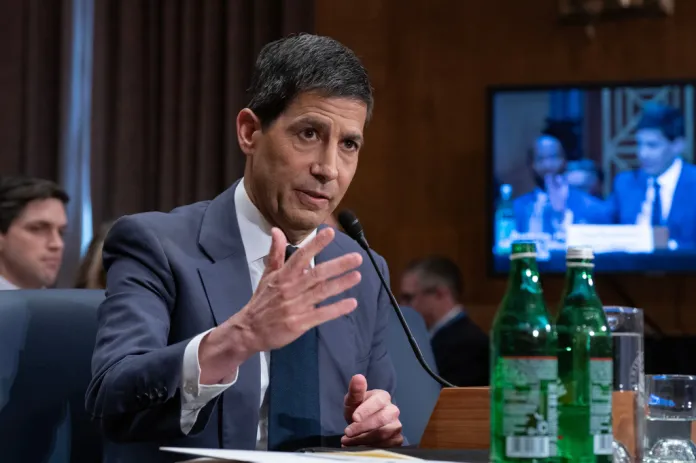
Kevin Warsh, who is set to become the next chairman of the Federal Reserve Board of Governors, is facing a big challenge this year as Chairman Jerome Powell announced he will remain on the Fed’s board and expectations for an interest rate cut fizzle out.
Warsh, 56, is President Donald Trump’s pick to lead the central bank and had his nomination advanced through committee last week. Warsh is expected to be confirmed before the Fed’s next meeting in June, but he is now facing a difficult macroeconomic landscape that has only become more tricky with Powell’s decision to remain on the board.
The problem facing Warsh is that Trump wants lower interest rates, but both the higher inflation environment and Powell’s remaining on the board are making that far less likely.
“It definitely makes it a complicated dynamic on the Fed,” Stephen Kates, a financial analyst at Bankrate, told the Washington Examiner.
And the complications with monetary policy and impediments to rate cuts are largely self-inflicted for Trump.
The war with Iran has caused energy prices to explode, driving up headline inflation. And Powell is staying on the Fed board in part because of the Justice Department investigation into him, which has since been dropped, and the ongoing attempt to fire Fed governor Lisa Cook.
Traditionally, Fed chairs retire from the board after their terms are up, allowing the president to fill the vacancy. While Powell’s term as chairman ends on May 15, his term as a member of the board runs until 2028.
Powell said he intends to keep a “low profile” but that he would stay on at the Fed to serve the “best interest of the institution and the people we serve.”
Powell’s plan to stay on the board will deprive Trump of a majority of seats on the Fed’s Board of Governors. Powell himself was initially nominated by Trump to be chairman, but he was renominated by former President Joe Biden and has since diverged from Trump on monetary policy.
And while Powell might take a backseat once Warsh comes on, the dynamic could still be an interesting one for Warsh to navigate — especially because Powell is well respected on the board and has been on the panel since 2012.
“It is a headache a little bit for Warsh,” Sean Snaith, an economics professor at the University of Central Florida and the director of UCF’s Institute for Economic Forecasting, told the Washington Examiner.
“It’s not like one member of the board or the [monetary policy committee] can filibuster rate decisions, but I think it would be an awkward situation,” he added.
There is not much precedent for a Fed chairman to stay on as a member of the Board of Governors.
In 1948, then-Fed Chairman Marriner Eccles declined to resign after his term as chairman ended and stayed on the board until 1951. But the Fed was a very different agency at the time.
Ryan Young, senior economist at the Competitive Enterprise Institute, said the Fed and the Treasury Department were essentially at loggerheads from the Great Depression through World War II, and the Treasury was dictating monetary policy at the time.
“And under Eccles, the Fed tried to reassert itself,” Young told the Washington Examiner. “And then, in 1951, they reached an accord where the Fed would handle the monetary side of things, and Treasury would stick to its domain in fiscal policy.”
“Basically, it was extraordinary times for the Fed, and that resulted in that extraordinary measure,” Young added about Eccles staying on.
Still, the current circumstances also arguably represent an extraordinary situation, Young said, because of Trump’s efforts to sway the central bank’s decisions about monetary policy.
If Powell stepped aside, Trump could replace him with a “yes man” who would push hard for rate cuts, Young said. Trump appointed economic adviser Stephen Miran to the board last year, and Miran has consistently dissented during Fed meetings, calling for interest rate cuts.
Nevertheless, Young said he thinks Powell is going to try to do his best to remain in the background.
Either way, markets are signaling that they do not believe that Warsh will be able to implement rate cuts. In fact, investors are betting that an interest rate increase is more likely than a cut by the end of the year.
As of Monday, the implied odds of a rate cut before the end of the year are just 5.5%, according to CME Group’s FedWatch tool, which calculates the probability of rate changes using futures contract prices for rates in the short-term market targeted by the Fed.
But the odds of a rate increase in 2026 have now risen to nearly 32% — up from 0% odds just one week ago.
Part of that is owed to economic reports that came in late last week.
In the Fed’s preferred inflation gauge, annual inflation jumped seven-tenths of a percentage point to 3.5% for the year ending in March. That is the highest such reading of the personal consumption expenditures index since May 2023.
Also, GDP grew at a 2% annual rate in the first quarter, rebounding from the quarter before and showing that the economy is still expanding and might be able to withstand higher interest rates.
“This is a tricky situation for anybody, no matter who’s coming in at this point,” Kates said. “It’s a difficult time to be transitioning in as Fed chair — inflation is accelerating, we’ve got conflicts abroad, we’ve still got some tail end of tariff impacts on goods prices. This is tricky.”
WARSH SET TO TEST LIMITS OF FED REFORM
And it is striking just how quickly the interest rate equation has seemingly changed. When Trump nominated Warsh in January, there was no war in Iran, gas prices were near their lowest levels in years, and inflation was at 2.4%.
“Between the higher budget deficits, the energy price spike, and the spillover effects that will have, that’s made Warsh’s job a lot tougher than it looked just a couple of months ago,” Young said.