You have full access to this article via your institution.

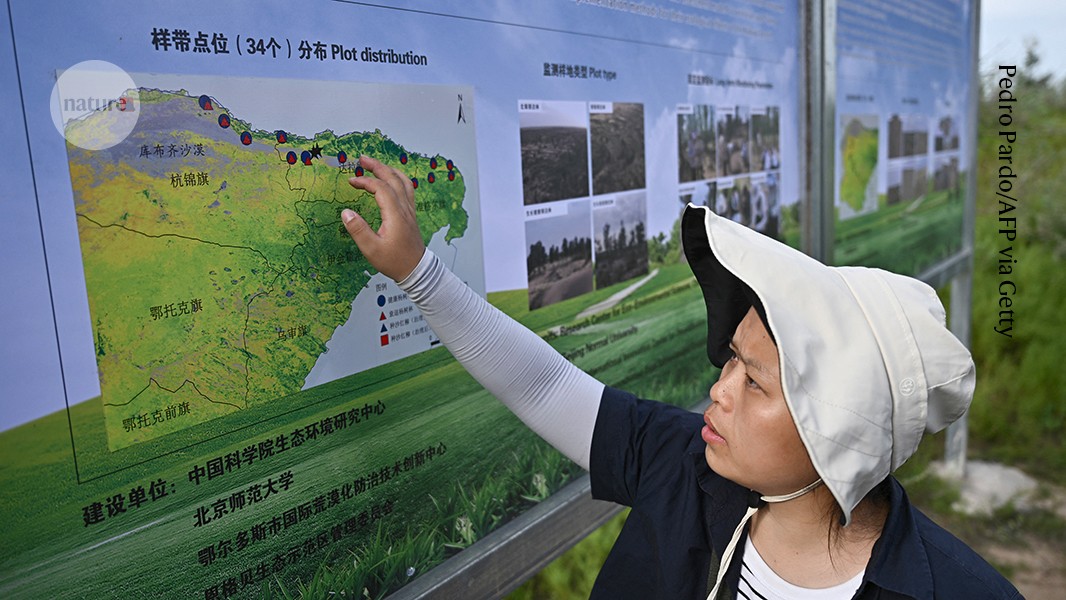
A student at work in the Kubuqi desert, one of the regions involved in the Great Green Wall of China in Inner Mongolia.Credit: Pedro Pardo/AFP via Getty
In Nature this week, researchers describe an initiative that is greening some of the world’s drylands — including deserts, shrublands and other water-scarce regions. The Great Green Wall of China, officially called the Three-North Shelterbelt programme, is one of the largest and longest-running projects of its kind. Outside China, the initiative is less well known than other programmes, such as Africa’s Great Green Wall. But, as Lilin Zheng, a researcher in geographical information systems at Shanghai Jiao Tong University’s School of Design in China and colleagues write, the project is succeeding whereas other green-wall initiatives are struggling. The programme’s strategies need to be studied — not only for land-restoration initiatives elsewhere in China, but also for those in other parts of the world, such as Africa.
Can China’s Great Green Wall shape efforts to keep the world’s deserts at bay?
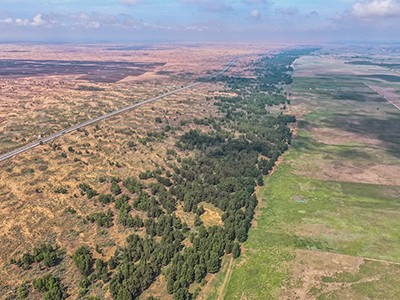
Initiated in 1978, the Great Green Wall is a network of forests and planted areas across northern China, spanning about 45% of the country. It is expected to be completed by 2050. A core aim of the project is to protect farms, villages, roads and railways from the encroaching Gobi and Taklamakan deserts.
The initiative has not been without challenges. In its first phases, there was large-scale planting of fast-growing species that were often ill-suited to the terrain. In Inner Mongolia, for example, trees struggled to survive and areas needed replanting. Overall, however, forest cover in the regions affected by the green wall has nearly tripled from about 5% in 1978 to just under 14% in 2023. The frequency and intensity of dust storms have fallen, improving air quality in downwind cities, notably Beijing.
Key reasons for this success are China’s long-term strategies and its predictable and continual funding, along with an emphasis on encouraging green-wall planners to learn from past experiences. For example, after 2020, China’s policymakers moved away from using the area of tree-planting as the only metric of success and have been experimenting with alternative measures of how land restoration benefits people and the environment. Such alternatives include analysing the effects of vegetation on the frequency and intensity of dust storms, as well as economic effects from planting, such as whether new jobs are being created.
For around a decade now, China’s desert regions have been home to large solar-power and wind farms. Green-wall planners are now planting vegetation around these renewable-energy facilities. The solar panels also provide shade, trap moisture, lower ground temperatures and help to reduce evaporation (Z. Xia et al. J. Environ. Manag. 324, 116338; 2022).
Past as present
Some of the effects of planting around these facilities are similar to those in old church forests in Ethiopia. Amid largely arid surroundings, these small pockets of woodland encircle churches, providing shade, shelter for buildings and biodiverse habitats. Forests covered nearly half of Ethiopia until land was cleared for agriculture during the late twentieth century. Today, there are perhaps no more than 35,000 of these islands of ‘sacred’ forest remaining and a race is on to prevent that number from shrinking further.
Is Africa’s Great Green Wall project withering?
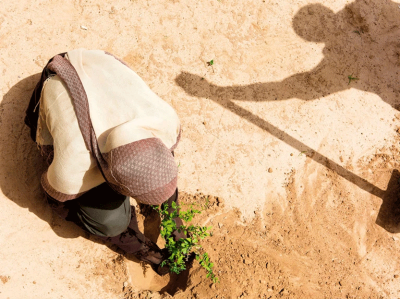
Ethiopia is one of several nations participating in Africa’s Great Green Wall, which has aimed to combat deforestation and desertification in a number of countries for nearly two decades. In Ethiopia, more than one million hectares of land have been restored since the country began to take part in the project in 2011, according to the United Nations Convention to Combat Desertification. Ethiopia had around 17 million hectares of forest land as of 2023.
Overall, however, the African green-wall project is not close to achieving its target of restoring 100 million hectares in 11 participating countries by 2030. One study, for example, published last year in the journal Land Use Policy, found that the project had relatively modest effects in Senegal (A. L. Zhu et al. Land Use Policy 157, 107670; 2025).
What can Africa’s green-wall planners learn from China’s Great Green Wall? Arguably, one goal for African nations must be to rely less on finance from international donors. There could be an incentive for African nations to move away from such funding because the governments of high-income countries that finance a large portion of the African green wall are making deep cuts to their international-development assistance.
Swathes of Earth are turning into desert — but the degradation can be stopped
In 2021, at a summit hosted by French President Emmanuel Macron, several organizations pledged a total of US$19 billion to Africa’s Great Green Wall. Despite these pledges, a relatively small fraction of the funds has found its way into projects on the ground in individual African nations. Governments need to view nature restoration not as a cost, but as an investment. Restoring degraded land and planting and protecting forests is as important as building other kinds of infrastructure, such as housing and railways. Human life cannot thrive without clean air, water, healthy soil and abundant biodiversity.
In their Comment article, Zheng and colleagues say: “Most green walls fail because of a lack of continual finance and maintenance.” Although African countries cannot commit to the same levels of spending as for China’s Great Green Wall, other aspects of China’s strategies can be replicated. These should include a degree of funding stability, building and testing interventions at small scales and learning from these experiences.