Holly Newson 00:00
Welcome to Working scientist, a Nature Careers podcast. I'm Holly Newson, and in this series, you'll hear from authors who can help you in your career.
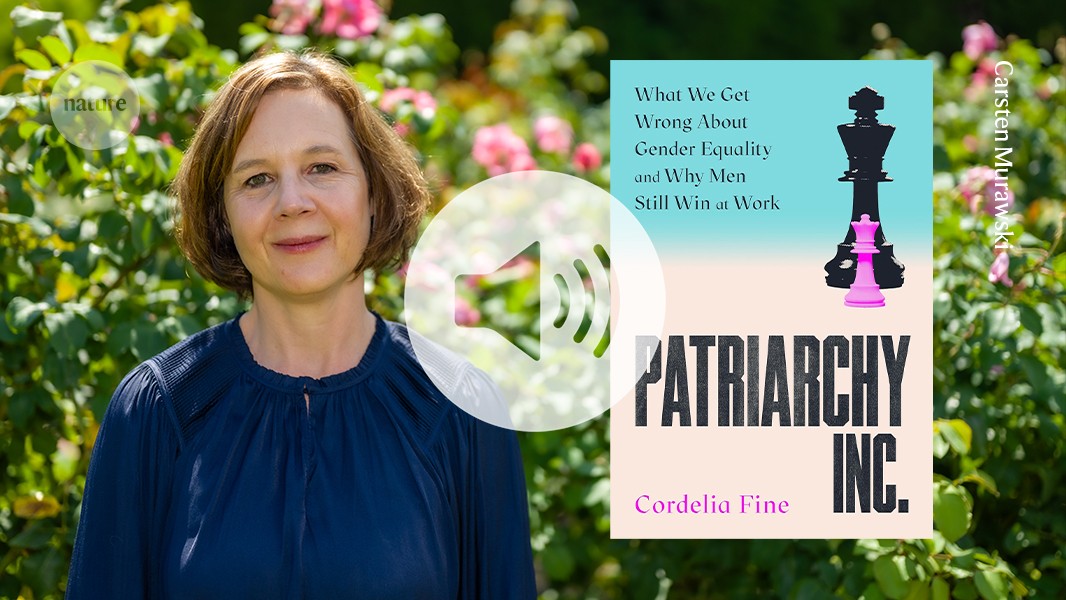
In this episode, I am joined by Cordelia Fine, an academic and the author of Patriarchy, Inc: What we Get Wrong About Gender Equality and Why Men Still Win at Work, a book that examines the existing role of gender in the workplace and why we need to change it.
Cordelia, thank you so much for joining me. (It's such a pleasure).
So to start off with, I wanted to ask, why did you want to write this book?
Cordelia Fine 00:32
I wanted to write this book because the topic of gender equality at work is so important, and I felt that these dynamics, these gender dynamics of who does what and who gets what, discussions about it have been derailed by what I saw as two kind of false visions of gender equality.
So one is a vision that's put forward by advocates of evolutionary psychology who say: “Look, we've kind of solved this problem. Yes, things were unfair in the past, but now, you know, women and men are just different but equal. They've evolved to have different kinds of values and motives and interests and skills. And so, yes, there are all these gender gaps in who does what, in leadership, in occupations, and yes, there are also some gender gaps in how much income people earn and how much wealth they accrue. But this isn't anything to worry about. This is just the reflection of natural differences in preferences, and, you know, fair market returns from a gender-neutral mechanisms of supply and demand.”
Then, on the other hand, we have what I call business case DEI, which has really kind of reframed this great civil rights movement to try and create equality regardless of, you know, gender, racial background, or whatever it might be, and reframed it as a problem of how to make more money out of women's labour as it so to so to speak.
You know, the slogan is, “gender diversity isn't just the right thing to do. It's also the smart thing to do because it can create more competitive organizations.”
And so I felt that this really important topic was sort of caught between one framing of gender equality that says “we're done, we've already got it.” And another that has reframed it to something completely different. That's pivoted it away from what originally it was all about, and which most of us, I think, ultimately, care about, which is creating a more just society.
Holly Newson 02:25
So I wanted to actually share some stats around women in STEM careers.
So women hold only 22% of STEM jobs in G20 countries, according to the 2024 UNESCO Changing the Equation: Securing STEM Futures for Women report.
Only 16% of fellows in science academies worldwide are women as of 2024.
In some countries, less than 10% of researchers are women.
And when we get to leadership, women make up just one in 10 leaders in companies relating to science, technology, engineering and mathematics.
So does that match up with what you found in your research when you were looking at all of this?
Cordelia Fine 03:04
Yeah, so, these sort of gendered, gendered patterns of occupational segregation, they're not completely straightforward.
And the idea that, you know, everything great goes to men, and everything rubbish goes to women, it's it's a bit more nuanced than that.
So for instance, you do see men over-represented in some of the, sort of, lower status jobs, and often ones that are, you know, particularly dangerous with high, high risk of physical injury or even death.
So it's not like all men are doing extremely well.
But when you, when you look at the sort of evolving patterns of men and women sort of ebbing and flowing into different kinds of occupations, you do tend to see that when an occupation becomes something that is, you know, starting to brim with opportunity, good employment prospects and higher status, then even if women were once, you know, a strong presence there, you tend to see this trend where men kind of buckle in and then the women, the women get pushed out.
So, you know, a really interesting specific example of that comes from women in Australian science.
So this was studied by the historian Jane Carey. And here I am sort of pulling the plough for the humanities.
But she, she sort of uncovered this extraordinary story, which was that, you know, white privileged, you know, well-educated, rich women in Australia had been a very strong presence in Australian science.
At a certain point in 1930, University of Sydney, which is one of, you know, our oldest, most prestigious universities, they made up, I think, 40% of science graduates in 1930.
And what she notices, though, is that after the war, when science became, you know, a better employment prospect, it became professionalized. It became something that you know was in a sense, worth doing, as opposed to more of an amateur hobby.
That was when men moved away from what was the then prestigious humanities degree. (those are the days!) into science.
And then we kind of had this collective amnesia about it.
So we kind of think about women entering science as something that was brought about with this, with the second wave, you know, feminist movement.
But actually, there have been periods in history where, where women have been, you know, really quite significant presence in science, or computer science, or clinical laboratories, or whatever, whatever it might be.
So yes, to come back to your question, but you know, STEM careers are highly-valued, they're secure jobs.
They're sort of, we see them as the solution to, you know, many of our problems.
And so it's not really surprising that we are seeing more men in those, in that workforce, and particularly at the highest levels.
That is quite a consistent pattern.
Holly Newson 05:52
Why is it that when men move into a career, when it's seen as more prestigious, that we lose that gender balance, that it doesn't just become half women and half men?
Cordelia Fine 06:07
Yeah, this is, this is where sort of thinking about people is like individual bundles of abilities and traits and values and preferences, that leaves out those gender dynamics, or those gender norms starts to starts to fail us.
So, you know, one dynamic that has been sort of documented through analysis of employment data from the UK is that even over quite short periods of time, a significant portion of occupational segregation, (so that's the segmenting of women and men different kinds of jobs) is actually due to men leaving occupations that are becoming too popular with women.
So that was work by sociologist Per Block.
And that really challenges those kinds of explanations that what we're seeing in our contemporary labour market is just women and men sort of freely choosing on the basis of their inherent preferences, that people are aware of the gender balance, the gender coding, if you want, of certain kinds of occupations, and they're responding to that.
But there was a fascinating qualitative interview with men who'd actually chosen to work in female-dominated occupations, like being a member of the cabin crew, or working as a librarian.
And the researcher noticed that the men were having to kind of do some work to overcome that discomfort of being in those female-dominated occupations, like they would re-describe being a librarian as sort of managing business information, or something like that.
Or point out the fact that cabin crew isn't just a service job. It's about safety and security, which is actually quite right.
It was originally all about safety and security, and the service was added later on.
So, yes, we have these, you know, if we think about gender as being this, you know, very salient organization, organizing principle of our social lives and the way that we categorize people, it's not really very surprising that some occupations, particularly if they're sort of rate, getting increasing or decreasing in the opportunities associated with them, will start to become gender-imbalanced.
Holly Newson 08:17
So you mentioned the kind of the job title thing there.
Can tweaking your job title affect how others treat or see you?
Cordelia Fine 08:29
What a great, what a great question.
I do know that there is work suggesting that it can make a difference to how appealing those particular kinds of jobs are.
And the study I'm thinking of in particular was interested in the effect of context on men and women's propensity to compete.
So in my previous book Testosterone Rex, I was kind of taking my magnifying glass to these claims that men have evolved to be inherently more competitive than women.
And one of these studies was showing that if you give exactly the same job (a kind of more female-sounding title), then women are more willing to compete to apply for that job than if it's given a more masculine-sounding one.
So that was a kind of, you know, one way of interpreting that is that when women feel like they're going to have a chance or belong, or be seen as someone who might do that job. They're just as willing to compete as a man.
So I think, I think these titles, I'm sure, do, do make a difference.
As well as what we emphasize, when we when we think about occupations.
And we think about nursing, for example, we kind of, you know, we tend to think about that, you know, caring, empathic aspect of it.
Well, I mean, some nurses are caring and empathetic. I have, I've encountered a few aren't and, you know, their job is a highly skilled technical job that requires a great deal of medical knowledge and technical skill.
But, you know, I don't know if that's what comes instantly to people's minds when. They think about nursing, for example, yeah.
Holly Newson 10:02
So tell me about cultural inheritance and how gender roles are bundled up in that?
Cordelia Fine 10:09
Yeah, so in Patriarchy Inc, I was, I was interested in, I guess, trying to tackle what I suspect is a popular perception that, if we're talking about this kind of two different kinds of explanations for gender phenomena like the division of labour.
And one is a kind of evolutionary explanation that involves, you know, genes, hormones.
And the other is a kind of, you know, the social creation, social constructionist kind of explanation.
And one very flourishing evolutionary programme is cultural evolutionary perspectives.
And for these, these kind of cultural inheritance and social learning, and the sort of accumulation of cultural traits, like skills, values, organizational forms, artefacts, practices and so on, is a really key part of how we solve problems.
And so in Patriarchy Inc, I was describing how the gender division of labour can actually be understood as something that is socially-learned and culturally-inherited.
And even when there's no kind of inherent advantage of, you know, males over females for a particular kind of job, it can still be more efficient to divide it, because sex is something that's universal to all human societies.
It's fairly salient already plays a sort of a quite important role in differentiating reproductive roles.
And so it becomes a sort of very easy way of deciding, well, you know, “you people, you know, with these genitals can do this. And you people with those genitals can do that.”
And because the groups that divide labour in that way have an advantage, you would expect them, expect that to sort of evolve over time as a kind of cultural adaptation.
And of course, there are societies where we have more than two gender categories. We create gender categories around sex.
Sometimes we can have more gender categories, but yeah, we can, when you actually look at the historical and cross-cultural and anthropological variation in the many different ways that humans divide labour, there's this, you know, it's a striking thing.
It seems to be universal. It's sometimes arbitrary. So in some societies, women will build shelter. In other societies, men will build shelter, but it's always there.
And the diversity that we see indicates that these are, you know, these are not sort of strongly-biologically determined roles that we have, but that they're, they're culturally evolved.
And, of course, they're constantly being shaped by the sort of broader social, economic and political forces, just like, you know, Australian science is a is a good example, yeah.
Holly Newson 12:57
So it's, it's the case that we've often divided labour, in some ways by gender, but actually the type of labour and where it sits, who does what, is not consistent anywhere. Is that right?
Cordelia Fine 13:11
So, there are some patterns.
So, and those are most consistent where there are kind of enduring physical differences between the sexes, relating to, in some cases, relating to reproduction.
So only females will get pregnant and breastfeed. And that can sort of offer some constraints on what kinds of forms of tasks and activities can be, you know, readily done by someone who's pregnant or has, you know, has to be on hand for nursing.
And men's greater upper body strength, in particular.
So you see some kinds of roles, like, you know, tree felling, that are all, you know, just pretty much invariably done by men.
But even then, you can see some sort of somewhat counterintuitive divisions of labour in the ethnographic record.
And as I said, many that are sort of just clearly arbitrary. Some places they're done this way. In some places they're done in other ways.
And of course, as we can see in our own historical relatively-recent historical record, there can be sort of fairly rapid changes in what's considered women's work and what's considered men's work, just showing how flexible it can be.
Holly Newson 14:18
And you mentioned motherhood, there.
Are women still discriminated in the workplace for being mothers?
Cordelia Fine 14:27
The simple answer is yes.
I mean, one ongoing issue is straightforward maternity discrimination.
I mean, obviously it's a little bit hard to get evidence on it, because organizations aren't falling over themselves to say, “Oh yeah, we got rid of her because she got pregnant.”
Okay, because it's illegal.
But you know, the data does suggest that maternity in particular, (though fatherhood can also be a sort of risky time in terms of in terms of employment), is still, is still an issue.
Now, in fact, when you look at the gender pay gap, for instance, some people have said, you know, fairly accurately, that it can in some ways be described as a motherhood pay gap.
Because there is a sort of various detrimental effects that our current economy workplace creates for mothers.
So we can have disproportionate sort of punishment for not having this uninterrupted career.
Part-time work can be less well paid, have fewer promotion and training prospects, and so on.
And then overall, of course, every time you, if you're working part-time, or you have time out of the pay force, you're not earning wages.
And so that income, of course, you know, in the ideal, the ideal situation, you're saving, you're accumulating wealth over time.
So this does leave women, and particularly mothers, with a real, not just an income gap, but also a wealth gap.
So some people would say, “Well, look, that's just, that's just a choice.”
But of course, we can ask, you know, why are women punished so much for motherhood? Why is there so little accommodation?
Why is it women who are spending so much time on parental leave compared to compared to men?
One thing that's interesting in looking at occupations that are, you know, female-dominated versus male-dominated, is that ones that are have a female concentration, like they actually just managed to deal with these, these, you know, the fact that we reproduce as a species, and we'll have to continue doing that if we want to continue as a species.
So one really nice example actually comes from, this is work from Lynda Campbell, who worked as a site, a cancer cytogenetic geneticist for many years. So that's looking at chromosomal abnormalities in cancer cells.
And then after she retired, she decided to do a PhD looking at the history of the field. And one thing that she'd noticed as soon as she moved into cancer cytogenetics in 1988 was that, you know, the lab that she worked in was completely female.
She was sharing an office with a female registrar who had her breast pump going because she was still breastfeeding her second child.
And because it was, you know, female-concentrated it wasn't a big deal to have a baby. You know, this was back in 1988 before flex work became a buzzword.
But part-time, work, maternity leave, job sharing, all of these things were accommodated without punishing women, without assuming that it meant they weren't committed or passionate about science. And ensuring that this highly trained scientific workforce weren't lost to science because it became too difficult to combine work and family.
So I think that's just one of these really nice examples of, you know, here's what we, you know, we sort of tend to think of as a scientific domain.
It's a, you know, it's a particular scientific, clinical, science field.
And yet, you know, it was full of women, and they, they just, and they just got on with it without, you know, without any discrimination towards mothers.
So there's nothing, there's nothing inevitable about it.
Holly Newson 18:19
And when we do see those kind of more what is now, I would say, a kind of a traditional parental expectation, where, you know, the mother is assumed will take off more time, off work, than the father. Do men lose out in that situation as well?
Cordelia Fine 18:38
Look, I mean, I think financially, they don't, they don't lose out.
But you know, the other way to see that, you know a bit more empathically, is that you know, if you have a heterosexual couple and you have a job that is demanding, the kind of ideal worker who you know doesn't work part-time is constantly available, is working long hours.
Then that breadwinning pressure does fall onto the father.
And we are seeing from surveys that there are fathers saying that, you know, they want to be more, you know, engaged in the sort of hands-on care of their family.
They would like to work fewer hours, even if it meant a cut in salary. But their jobs don't allow it.
And, you know, there's some, some evidence suggesting that, you know, it's even harder for men to get the flexibility that they need in the workplaces, because they're violating two norms.
They're violating the norm of, you know, the ideal worker who doesn't work part-time or flexibly.
And they're violating the norm of, you know, a man, and that's not....his job's the breadwinner, not the carer.
Now, of course, there's lots of variation.
And you know, some organizations are much further on in that journey of normalizing the idea that, you know, everyone has a family life as well, and, you know, interdependencies, and so on.
For other organizations, it's still, you know, very much a violation of that norm to even take a few weeks parental leave.
For example, I was just at a university symposium today.
I won't name the university, but they're presenting some of their statistics on the uptake of carers leave by men. And you know, it was about 95% of that leave was going to women, and 5% going to men.
So that's a really big gap. And you know, we're not talking...if you think about an entire career, not talking about a very long period of time here. So that does speak, I think, to the power of these norms.
Holly Newson 20:33
And let's talk about DEI (diversity, eqiuty, inclusion) initiatives.
So what do you think of them in terms of actually creating progress towards equality? Do you think they have some value there?
Cordelia Fine 20:49
There's a whole suite of DEI initiatives.
And you know, a lot of them will have a degree of merit to them. So I'm certainly not kind of dissing everything that comes under the DEI banner.
But people who work in this area do get a little bit frustrated that often the most popular forms of diversity initiatives are the ones for which there is the least evidence that they're actually successful.
So you know, one example of that category is what is sometimes referred to as fixing the women.
So sending women to development or leadership programmes, encouraging them to lean in, for example, to remedy their supposed lack of ambition, or risk-taking.
And there's really no evidence that this works.
And of course, it doesn't, it leaves unaddressed the kinds of issues that I was talking about before. That the problem isn't, you know, really that women fail to lean in, but they're more likely to be in jobs where there isn't simply, there simply isn't the opportunity to negotiate over wages.
Or if they do negotiate, they're less likely than a comparable man to actually be successful.
So these are not problems in women that need fixing, but problems in organizations and in systems.
Another popular but not terribly effective diversity initiative is the diversity training, or unconscious bias training.
This has been studied for decades and decades. And there really isn't good evidence that it's effective.
So it is unfortunate there that there has been a lot of time and energy put into DEI initiatives that are not necessarily very effective.
And I think one of the, the form of DEI that I particularly take exception to in the book is this sort of business case framing of it.
You know, “it's not just the right thing to do, but the smart thing to do.”
And there's a couple of reasons for that.
So one is that the...it's kind of offensive to the people that it's supposed to be benefiting.
So this was actually research done by Aneeta Rattan and a colleague, and they showed people kind of women from women who are interested in STEM careers, or LGBT minorities or racial minorities.
And they showed them these kind of business case, organizational diversity cases, compared to one saying” We value diversity just because it's fair.”
And they found, maybe not unsurprisingly, that people were much more interested in working for an organization that valued diversity because they wanted to have a fair organization to represent the community that they were serving, and one that wanted to profit out of, out of diversity.
And you know, they were worried more that in those kinds of organizations they would be, you know, exploited to make the company look good.
They would be treated as kind of interchangeable with other, you know, other female STEM workers, or other racial minorities and so on.
So, you know, if the way that you're framing your why you care about diversity is sort of a bit off putting to even the people that you want to supposedly are helping, then that's not, that's not a great start.
But I think, you know, maybe the major reason is that where you're saying, “Look, this is all about leveraging women's labour,” then it just seems that certain kinds of forms of reducing inequality are just going to be off the table.
So whether that's, you know, increasing the wages of undervalued female labour, for example, or, you know, creating more secure work for precarious workers.
So just framing it in that way kind of takes a whole, sort of suite of possibilities off the table, while at the same time soothing people.
That, “look, we can just rely on people's self-interest,” and you know, equality will somehow, somehow come about. So it's just a very naive faith in market dynamics.
Holly Newson 25:00
And obviously we've also seen some DEI initiatives fall out of favour because of politics, in kind of recent times.
So do you think that when the political climate changes, we can replace DEI as it was, with something better, and if so, what do you think that better could look like?
Cordelia Fine 25:28
I think when people talk about diversity initiatives, you can draw distinctions between different kinds of changes that you make to the organization, and the extent to which they're kind of singling out women or other underrepresented groups.
And, you know, all else being equal, the less you can sort of single out women, the better.
Okay, here's an example which I think is a nice one from, you know, academic work or science, for example.
Which is that, you know, if you take a career break because you're on maternity leave or parental leave or something like that, you know you lose momentum. And that can be very damaging in, you know, very competitive academic or scientific career.
And one way to address that is to say, “Look, when you come back from parental leave, we're going to give you some extra support to help you get your, you know, to rebuild that momentum.”
And you don't have to say this is for women, or this is for mothers.
You can say this is for anyone who's coming back from a career interruption. Doesn't even have to be because you had a baby. It might be that you had to care for an elderly person, or you're unwell or something.
And this is just a sort of, this is a really sensible thing to do. Like, you know, it's not that because somebody has taken their foot off the gas for a few months in a long career that suddenly they don't deserve to succeed.
But it's also not singling at women in a way that can, can sort of foster resentment, and can, can be divisive.
So these are just ways of, you know, I guess creating more fairness, sort of, in a sense, a merit enhancing, in making sure that, you know, really good, capable, committed people can stay in the game.
But without, sort of, without sort of dragging people into diversity training that, you know, implies that, you know, “we think that you're biased, you need to do this.”
Or sending women off saying, you know, “you need to, need to be developed. So we'll send you off, right?”
And then the men are like, “Well, why don't we get to, go to, the, you know?”
So if it's not effective and it's fostering resentment, not a great idea.
And there are things that we can probably do that are going to be helpful across the board, that are going to enhance fairness, but that are also going to maybe disproportionately help, you know, women, for example, or other groups.
You know, another example is in Australia, the Australian Research Council, a decade or so ago, started implementing changes so that you are looking at your performance record relative to your opportunity.
So again, this is a way, and they've been refining it over time, a really great way of making sure that having that career interruption for whatever reason it might be, doesn't, sort of, isn't the death knell for your career. And it's been successful.
And I think, you know, maybe there were, there was qualms about at the time, I don't know.
But it's, you know, it's very accepted now, and it just, it just makes sense that people shouldn't be unfairly or disproportionately punished because they're not conforming to this ideal worker norm that, you know, assumes that someone else is taking care of every other aspect of your of your life, and you'll never get ill. Nobody you love will ever, will ever get ill.
So I think, I think maybe, if we want to find a silver lining in this sort of political anti-DEI moment, is it that it might encourage people to think maybe a little bit more strategically about diversity initiatives that you know that are maybe less divisive and more effective?
Holly Newson 29:21
So what did that look like in Australia when they were using past performance to dictate opportunity? Do you know how that was structured?
Cordelia Fine 29:32
So well,, they still, they still do this. And as I said, they've been refining it over time.
And so what we have now is a situation where, you know, in order to sort of protect the sort of privacy of the person applying, so they're not having to sort of provide a lot of huge amount of personal or family information to the people who are assessing their applications, but it's just giving the assessors a sense of “how much opportunity has this person, how long have they had, you know, how much time have they had to do research versus teaching, for example?”
And, you know, so it's, it's, rather than looking at, well, this person got their PhD on this date. And now that's 20 years. So I'm expecting my 20-year CV.
It's, it's sort of like, well, they've had this many years of teaching and research opportunities. And that's actually also helpful for people who have ended up with heavier teaching loads, which, of course, you know, constrains how much research one can expect from them. And ensuring that they also have a, you know, fair opportunities to compete for competitive grants.
So yeah, I think it's a great system.
As I said, it's been refined over time, and I believe the evidence shows that it has ensured that people who have had career interruptions are not disadvantaged when it comes to applying for grants.
And universities implement this now in their promotion, their promotion, as well.
And it's about a focus on quality, not just quantity, which actually, putting on my philosophy of science hat, there have been worries, you probably heard about the replication crisis.
You know, the competition involved in science that you know, the publish or perish career structure you know, does tend to incentivize research that is maybe, you know, fulfilling career, career values, rather than, you know, epistemic ones, sort of really solid, reliable science.
And I, I think that, you know, shifts towards moving towards a sort of, you know, quality of science will not just benefit people who can't, you know, be working at 110% all of the time, but may actually even be an advantage in terms of sort of, you know, slightly reducing that pressure on people to, you know, publish it, publish at all costs, which is something which the scientific community does worry about.
Holly Newson 32:00
And in talking about the scientific community, do networks and relationships affect success differently for different genders?
Cordelia Fine 32:12
Yeah, so I think networks are so important.
And this is where you come up with this difficulty because you can, you can be scrupulously unbiased when it comes to evaluating someone's CV or promotion application or job application.
But if there's been sort of disadvantage in the moments leading up to that, then you know, you're not actually, the equal opportunity isn't there.
So you know, as with any, any other professional career, you know, all of us benefit from, you know, the relationships that we have.
People, people offering us useful advice, reading our papers, giving us access to labs or useful information, offering us an opportunity to contribute to a special issue of a journal, or be on a panel, or all of these things that can enhance our CV, or enhance how competitive we are.
And you know, it's just the unfortunate case that we do tend to be more attracted to people who are like ourselves in, on various dimensions, and that can just mean that a lot of the disadvantage in science, as in other places, can be nothing to do with overt prejudice or intention to be sexist or racist, but just people doing good things for other people that happen to be happen to be like, like themselves.
So yes, certainly, networks are very important.
And, you know, this is one of the interesting examples. I mentioned Lynda Campbell, who'd worked in cytogenetics, and she was taking oral histories of the key figures in the field, many of whom were women.
And one of the interesting things that came out of those interviews was the way that these women, you know, back in the 80s, you know, but quite senior and influential.
And you know, they were, they were like the old girls network, right?
So often, they were helping other women, talented women, get, get opportunities.
And, you know, we would hope that these things should flow across, across genders.
And it's, course, it's not. I'm sure that there are plenty of people. I mean, I've had male mentors and sponsors in my career who have been wonderful people, who have been a great assistance to me.
So of course, it's not that we are all along completely gender segregated lines.
But it is it is something that we need to be, need to be aware, aware of.
And that kind of disadvantage can kind of get inherited through the, through the sort of, you know, scientific legacy or family, so to so to speak, if we don't, if we're not careful.
And that's why, you know, one of the more effective forms of diversity initiatives, are mentoring programmes.
And particularly ensuring that they're cross-gender and cross-race. So there can be an appeal to saying that you know, this is you know women, women scientists. They should have you know, female senior female mentors.
The research suggests that they can, like female senior female mentors can be very helpful psychosocially.
They can sort of, you know, help with some of the challenges of being in that scientific environment. But in terms of career advantage, the research suggests that actually, you're, it's better if those flows of useful information and so on are crossing, crossing the gender lines.
Holly Newson 35:40
So, taking into account all the research that you've done, is there something that you would like in particular to see happen in workplaces and beyond, to address the many facets of workplace gender inequality?
Cordelia Fine 35:56
Well, there's, yeah, there's no, there's no sort of magic bullet for this issue. You know, a few things that one can say.
And of course, part of what's so fascinating about this topic is that different organizations can be very different.
Like even within the same industry, these gender dynamics can be quite different. So it's hard to get sort of one-size-fits-all solutions.
But I think generally, sort of moving, continuing this movement towards an economy and a workplace that recognizes that at certain points in everyone's life they're going to have, you know, significant responsibilities outside of their paid work, and to, you know, to accommodate that and to make it easier for fathers and men to engage in that kind of work.
And so long as it's disproportionately punished, men aren't going to be, you know, rushing to take on those costs.
But I think, you know, in terms of thinking about science, maybe a few things to say, thinking about gender gaps, and gender inequalities in science.
So, you know, scientists love evidence, and there are a couple of really great evidence based books there around diversity initiatives. So one is Getting to Diversity, by Frank Dobbin and Alexandra Kalev, and the other is Make Work Fair, which came out, I think, this year by Iris Bohnet and Siri Chilazi.
These are, these are really great books full of the evidence that's available, the best evidence that we have. And I think people who are, you know, curious about, you know, what, what might work in my particular organization, for my situation, could just look through those books and think, actually, you know, I think this might, might be something that might be effective or positive for my environment.
But I guess one thing that I want to say, you know, again, with this sort of philosophy of science hat on, is that when it comes to science, I just would encourage people not to be complacent, to not say, “Oh, look, but we're different, but equal, and we're just, pushing at a door that's been shut by nature.”
I take this view seriously, but I think overall (and people can take a look at the book and decide for themselves), but I don't think the evidence supports this comforting, different but equal story that says that the gender division of scientific labour is just reflecting our kind of, you know, natural, biological predispositions.
And you know, on one last point, I think you know, through the history of science, we have these stories about why this division of labour is the natural order of things.
So, you know, when women were...laboratory work was women's work, it's because women are so patient, and they don't seek the limelight for themselves.
And they're very good. They're patient. They don't mind doing this boring, repetitious work.
We came up with all these sort of explanations of why, you know, men were sort of leading the research agendas, and women were the technicians supporting them.
And you know, we still see in science, we still see these attempts to, sort of link these 21st century modern science to, you know, to hormonal differences between the sexes.
And I would just encourage people who are interested in these scientific debates about why we see these gender gaps, and they really are, you know, they're interesting debates.
I've been grappling with them for over a decade, to just spend some time looking at the insights from the humanities and the social sciences.
And taking a look at the evidence for the historical and the cross-cultural variation in who's participating in science, and the stories that we tell about, you know, why they do or don't belong there.
Because, at the end of the day, these simple biological explanations are just not going to cut it.
Holly Newson 39:47
Yeah. Well, Cordelia, thank you so much. It's been such a pleasure to chat to you. I really, really enjoyed reading Patriarchy Inc.
And, yeah, I think the research that you do is very needed. So thank you so much.